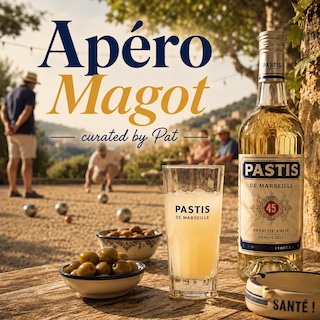
French chanson’s answer to emotional chaos is apparently a beautiful melody and excellent diction.
Pour generously, press play, and let the French deal with love, longing and heartbreak, preferably before the second glass. Santé! 🇫🇷🥂
| Title | Artist | Comment |
|---|---|---|
| C’est en septembre | Gilbert Bécaud | A nostalgic celebration of September as a moment when summer memories, romance and the changing seasons become especially vivid. Bécaud turns the end of summer into something positive rather than sad. Born in Toulon, France, Monsieur 100,000 Volts was famous for his extraordinary stage energy and for songs that combined grand melodies with everyday emotions. |
| Ne m’oublie pas | La Grande Sophie | A tender reflection on memory and the fear that a relationship or shared experience might gradually disappear. La Grande Sophie, born in Thionville, France, is a major figure in modern French chanson/pop, known for combining acoustic songwriting with contemporary arrangements. The song fits her recurring interest in relationships, time and emotional independence. |
| Les Enfants de mes enfants | Claude-Michel Schönberg | A forward-looking meditation on future generations, imagining the lives of one’s grandchildren and the world they will inherit. Schönberg, born in Vannes, France, is better known internationally as the composer of Les Misérables and Miss Saigon. This song reveals the singer-songwriter side of an artist subsequently associated much more strongly with musical theatre. |
| La Poupée qui fait non | Michel Polnareff | A playful portrait of an elusive girl who continually says “no”, turning romantic frustration into catchy pop. Written by Polnareff with lyricist Frank Gérald, it became his breakthrough hit. Born in Nérac, France, Polnareff combined French chanson with Anglo-American rock, psychedelia and flamboyant visual presentation. The song became a French pop standard and has been covered internationally. |
| Ensemble | Art Sullivan | A straightforward celebration of togetherness: love is presented as something that makes life more meaningful when experienced together. Belgian singer-songwriter Art Sullivan, born Arthur de Greef in Brussels, Belgium, enjoyed enormous popularity in continental Europe during the 1970s, particularly with romantic, melodic chansons. |
| Amoureux Fou | Herbert Léonard & Julie Pietri | Literally “Madly in Love,” this dramatic duet portrays two people caught between overwhelming attraction and emotional uncertainty. Herbert Léonard, from Strasbourg, France, was a prominent romantic singer and also a member of the rock group Les Jets. Julie Pietri, born in Douera, Algeria, became one of the major female voices of French pop in the 1980s. The conversational duet format makes the emotional push-and-pull particularly effective. |
| Si tu m’aimes | Juliette Gréco | A classic declaration of love and vulnerability, asking whether affection can be trusted and reciprocated. Gréco, born in Montpellier, France, became one of the defining voices of existentialist Paris and the Saint-Germain-des-Prés cultural scene. Her repertoire included works by some of France’s most important poets and composers, and her delivery often made a love song feel like a philosophical proposition. |
| Les Feuilles Mortes | Yves Montand | A meditation on lost love, memory and the passing of time, using autumn leaves as a metaphor for things that have disappeared. The song was written by Joseph Kosma, with French lyrics by Jacques Prévert, for the 1946 film Les Portes de la nuit. Montand’s 1949 recording helped establish it as a French standard. The English adaptation, “Autumn Leaves,” subsequently became a jazz standard. |
| Que Reste-t-il de nos amours ? | Stacey Kent | The title asks the devastatingly elegant question: “What remains of our loves?” Charles Trenet’s original looks back on a vanished romance through memories of places, seasons and small details. American jazz singer Stacey Kent, born in South Orange, New Jersey, USA, brings the song into a sophisticated contemporary jazz setting. Her interest in French repertoire has made her particularly popular with Francophone audiences. |
| Chère amie (Toutes mes excuses) (ft. Françoise Hardy) | Marc Lavoine | A sophisticated exchange about friendship, love and the complications that arise when emotions refuse to remain neatly categorised. Marc Lavoine, born in Longjumeau, France, became known for his intimate, cinematic pop chansons. The collaboration with Françoise Hardy, from Paris, adds a particularly elegant dialogue between two generations of French pop. |
| Amoureuse | Véronique Sanson | One of Sanson’s defining songs, describing the exhilarating but destabilising experience of being deeply in love. The narrator feels both liberated and vulnerable, capturing the emotional turbulence of romantic obsession. Sanson, born in Boulogne-Billancourt, France, became one of France’s most influential singer-songwriters, particularly admired for her piano-based compositions and emotionally direct performances. The song became internationally known through numerous adaptations, including “Emotion” and other versions. |
| Sous le charme | Khadja Nin | A sensual, atmospheric song about being captivated or enchanted by someone, with love portrayed as an irresistible force. Khadja Nin, born in Kigoma, Tanzania, and raised in Burundi, became an important international voice combining East African musical traditions with African pop, jazz and European influences. Her multilingual repertoire reflects her culturally diverse background. |
| Je suis malade | Serge Lama | One of French chanson’s great portraits of emotional devastation. The narrator describes himself as physically and psychologically “sick” because of a relationship that has collapsed. Written by Serge Lama and Alice Dona, the song is intensely personal in tone, although its exact autobiographical basis is less important than its dramatic portrayal of heartbreak. Lama, born in Bordeaux, France, became renowned for theatrical, emotionally uncompromising chanson. |
| Il me dit que je suis belle | Patricia Kaas | A sophisticated song about the intoxicating power of being told you are beautiful by someone whose opinion matters deeply. Written by François Bernheim and Jean-Jacques Goldman, it combines vulnerability with a subtle awareness of romantic manipulation and desire. Kaas, born in Forbach, Lorraine, France, became internationally known for her smoky voice and blend of chanson, blues and pop. |
| Un homme heureux | William Sheller | A deceptively simple reflection on contentment and emotional fulfilment, celebrating the possibility of being genuinely happy rather than constantly chasing something else. Sheller, born William Hand in Paris, France, is a classically trained composer and sophisticated French singer-songwriter. His ability to combine pop songwriting with orchestral and classical influences is particularly evident here. |
| Je range | Zita Swoon | The title literally means “I’m tidying up.” Zita Swoon turns the mundane act of putting things away into a more reflective metaphor for sorting through memories, emotions and the remnants of a relationship. The Belgian group, led by Stef Kamil Carlens, originated in Antwerp, Belgium, and became known for blending indie rock, soul, folk and experimental pop. The understated subject matter is characteristic of their ability to find poetry in everyday life. |
Sources
The information sources of the song facts include, but are not limited to, Wikipedia, songfacts.com, discogs.com, secondhandsongs.com, YouTube and artists’ related websites.