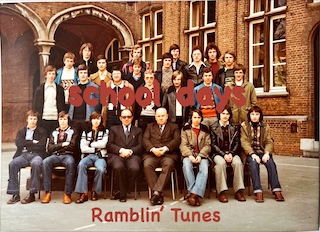
(part 3 of the trilogy) still got that easy chair around? Come and move closer to the speaker and let me indulge you with another ninety minutes of delicate songs
| Title | Artist | Comment |
|---|---|---|
| Listen to the radio | Tom Robinson Band | Tom Robinson’s autobiographical “Listen To The Radio” was co-written with Peter Gabriel. |
| Wish You Were Here | Pink Floyd | “Wish You Were Here” by Pink Floyd was written by songwriters Roger Waters and David Gilmour, inspired by founding member Syd Barrett’s ordeal with schizophrenia. The sound coming from an AM radio somewhere in the distance represents the distance between the listener and the music. “Wish You Were Here” is the title track to Pink Floyd’s ninth album, their follow-up to The Dark Side Of The Moon. |
| Don’t give up (ft. Kate Bush) | Peter Gabriel | A newspaper article about a woman killing her child and herself, depression and a nervous breakdown inspired Peter Gabriel to write this song, released in 1986. |
| Fix You | Coldplay | This song deals with true love, helping someone in your time of need, and learning from your mistakes. According to Gwyneth Paltrow, she was the one Coldplay lead singer Chris Martin was trying to help fix. Paltrow met Martin in 2002 just a few weeks after her father, the actor Bruce Paltrow, passed away. When he appeared on The Howard Stern Show in 2015, she explained: “‘Fix You’ was about him trying to put me back together after my dad died. I think it’s pretty nice.” Martin and Paltrow got married in 2003 and had two children together before breaking up in 2014. |
| Have a Little Faith in Me | John Hiatt | “Have a Little Faith in Me” is a song written and performed by John Hiatt that appears on his 1987 album Bring the Family. The song was the first song written by Hiatt following his sobriety from drugs and alcohol, which had contributed to his marriage breakdown and his being released by former record labels. Hiatt’s original attempt at recording the song took place at a friend’s studio and included a larger instrument accompaniment. However, the recording was plagued by technical issues. The morning after, Hiatt was informed that his estranged wife had committed suicide. Hiatt attributes the technical problems with the original recording as a sign that the song was not meant to be heard that way, and he eventually released the song with a much simpler piano accompaniment. |
| Eres mi religión | Maná | “Eres Mi Religion” is a timeless love anthem about finding your soul mate and being devoted to them. |
| Lean On Me | Bill Withers | “Lean on Me” is a song written and recorded by American singer-songwriter Bill Withers. It was released in April 1972. Bill Withers’ childhood in the coal mining town of Slab Fork, West Virginia, was the inspiration for “Lean on Me”, which he wrote after he had moved to Los Angeles and found himself missing the strong community ethic of his hometown. He had lived in a decrepit house in the poor section of his town. |
| All By Myself | Eric Carmen | “All By Myself” written and performed by Eric Carmen is among the most-played songs in U.S. pop history. Eric Carmen was inspired by by Leonard Bernstein’s “West Side Story” and The Beatles movie “A Hard Day’s Night” to kick-off his career. |
| Hello | ADELE | “Hello” was written by Adele and Greg Kurstin and produced by Kurstin, who also played bass, guitar, drums, piano and keyboards, while Adele played drums. |
| Holding Back The Years | Simply Red | Simply Red is fronted by singer-songwriter Mick Hucknall (“Red” was his nickname because of his red hair). Hucknall didn’t realize what the song was about until he’d finished it. “It’s about that moment where you know you have to leave home and make your mark, but the outside world is scary,” he explained. “So you’re holding back the years.” |
| Lazarus | David Bowie | The title song from David Bowies musical Lazarus taken from the album Blackstar. The show opened in New York in December 2015, and was a sequel to his cult classic movie The Man Who Fell to Earth where he played the lead Thomas Jerome Newton. Speaking to the New York Times, the musical’s director Ivo van Hove said: “Lazarus focuses on Newton as he remains on Earth, a man unable to die, his head soaked in cheap gin, and haunted by a past love.”. The song took on new meaning after Bowie passed away on January 10, 2016, two days after the Blackstar album was released. |
| Chère amie (Toutes mes excuses) (ft. Françoise Hardy) | Marc Lavoine | Marc Lavoine wrote and released “Chère amie (Toutes mes excuses)” first in 1990 and recorded a duet with Fançoise Hardy in 2007. |
| When a Blind Man Cries | Deep Purple | “When a Blind Man Cries” by Deep Purple was initially recorded during the Machine Head sessions in December 1971 in Montreux, Switzerland during a short break from touring. |
| U-Turn (Lili) | AaRON | AaRON (acronym for Artificial Animals Riding on Neverland) is a French musical duo made up of Olivier Coursier and lead vocalist Simon Buret. “U-Turn (Lili)”, which was released in 2007, is their debut single and in a way most-successful one. This song also made its way onto the soundtrack of Je Vais Bien, Ne T’en Fais Pas (aka “Don’t Worry, I’m Fine”), the 2006 French movie starring Mélanie Laurent. |
| You do something to me | Paul Weller | Paul Weller commented on this song “This definitely strikes a chord in people’s hearts, a song for lovers. I’m told by some many people they had it played at their wedding, the first dance…Ironically, it’s really about unattainable love. But you can interpret it whichever way you want.” |
| The Blower’s Daughter | Damien Rice | The ballad “The Blower’s Daughter” is written and performed by Irish musician Damien Rice, most likely inspired by Irish singer Lisa Hannigan, who features in the song and was in a relationship with Rice until 2007. |
| Here’s to Love | Jasper Steverlinck | “Here’s to Love” is written, composed and performed by Jasper Steverlinck in 2017. Jasper Steverlinck (born 30 April 1976) is a Belgian Flemish singer and guitarist for Ghent-based Arid. |
| Che vuole questa musica stasera | Peppino Gagliardi | Gaetano Amendola, Neapolitan lyricist, who often wrote with Peppino Gagliardi with whom he wrote many successes, like “Che vuole questa musica stasera”. Giuseppe Gagliardi was born in Naples on May 25, 1940 and died August 9, 2023. “Che vuole questa musica stasera” (Who wants this music tonight) is part of the original soundtrack of Scent of a Woman (Italian: Profumo di donna) in 1974 and the 2015 movie “The Man from U.N.C.L.E.” |
| La Solitudine | Laura Pausini | “La solitudine” (“The Loneliness”) is an Italian ballad recorded by pop singer Laura Pausini released as her debut single in February 1993. The lyrics to the Italian version of the song where are about a boy named Marco, who is separated from his girlfriend at the urging of his family and sent to live far away from her. The now former girlfriend makes an emotional and heartfelt plea, singing to him about the loneliness and pain they would feel without each other. In 1994 Pausini released a Spanish-language version of the song, titled “La soledad” and an English-language version, adapted by Tim Rice, titled “La solitudine (Loneliness)” in 1995. |
| Perfidia | María Dolores Pradera | “Perfidia” (Spanish for “perfidy”, meaning faithlessness, treachery or betrayal) is a 1939 Spanish-language song written by Mexican composer and arranger Alberto Domínguez (1906–1975) from the perspective of a man whose lover has left him. The song has also been recorded in English (with lyrics by Milton Leeds) and as an instrumental. Dame María Dolores Fernández Pradera (29 August 1924 – 28 May 2018) was a Spanish melodic singer and actress, and one of the most famous voices in Spain and Latin America. Pradera recorded the song in 2006 with Los Sabandeños Spanish folk band from Tenerife, Canary Islands, founded in the sixties by a group of friends at the university of La Laguna. |
| Delicate (ft. Des’ree) | Terence Trent D’Arby | “Delicate” is a song by American singer-songwriter Terence Trent D’Arby (born Terence Trent Howard; March 15, 1962) featuring English singer Des’ree, released on June 7, 1993 |
Sources
The information sources of the song facts include, but are not limited to, Wikipedia, songfacts.com, discogs.com, secondhandsongs.com, YouTube and artists’ related websites.