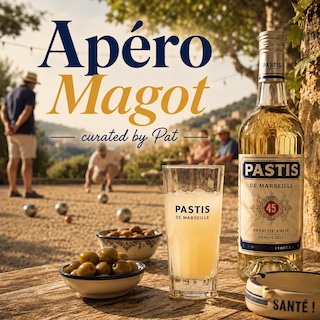
This playlist is practically an apéritif in musical form: flirtation, marriage, jealousy, nostalgia, freedom, romance and the occasional romantic disaster, all served with a generous helping of French charm. 🥂🇫🇷🎶
| Title | Artist | Comments |
|---|---|---|
| Tchin, Tchin | Richard Anthony | A cheerful toast to love, friendship and good times, built around the familiar tchin-tchin sound of glasses being raised. Richard Anthony, born Richard Btesh in Cairo, Egypt, was one of the major French yé-yé singers and specialised in adapting international pop hits for French audiences. The song is an adaptation of “Cheat Cheat” by Johnny Cymbal. |
| Moi vouloir toi | Françoise Hardy | A playful, direct expression of desire, with the deliberately simple title giving the song a teasing, almost childlike quality. Hardy, from Paris, France, was by then moving beyond her introspective 1960s sound into more sophisticated 1980s pop. The contrast between her normally restrained persona and the directness of the song is part of its charm. |
| Amoureux de ma femme | Richard Anthony | A humorous romantic dilemma: the narrator is deeply in love with his own wife, turning marital devotion into a surprisingly catchy confession. Anthony’s relaxed delivery keeps it playful rather than overly sentimental. It belongs to the tradition of French pop songs that turn ordinary domestic relationships into amusing little stories. The original version, titled “Nessuno mi puo’ giudicare” (No one can judge me), dates from 1966, first performed at the San Remo Festival, by Italian singer Caterina Caselli. The lyrics are by Miki Del Prête and Luciano Beretta and the music is by Daniele Pace and Mario Panzeri. |
| Quand on est amoureux | Enrico Macias | A warm celebration of the way love changes one’s perception of the world: when you’re in love, ordinary life becomes brighter and more meaningful. Macias, born in Constantine, Algeria, became one of France’s best-known Mediterranean-influenced chanson singers after moving to France. His repertoire frequently combines romance with themes of belonging and human connection. |
| Ma Femme | Sacha Distel | A playful, affectionate portrait of married life, delivered with Distel’s trademark sophistication and light touch. The song is an adaptation of the song “Oh no no”, with the orchestral direction provided by its original performer, Bernie Paul. Distel, born Alexandre Sacha Distel in Paris, France, was both a hugely successful pop singer and an accomplished jazz guitarist. His ability to move between jazz, chanson and easy-listening pop made him one of France’s most effortlessly suave entertainers. |
| Vous Permettez, Monsieur | Salvatore Adamo | A charmingly old-fashioned young man asks a girl’s father for permission to take her dancing. The song captures romance, manners and generational etiquette with a wink. Written by Adamo, it became one of his breakthrough hits. Born in Comiso, Sicily, and raised in Belgium, Adamo became one of the biggest French-language pop stars of the 1960s. Adamo told (on radio Classic 21) he had sung this song when he had been invited to sing at a reception given by the Belgian royal family. |
| Foule sentimentale | Alain Souchon | A witty critique of consumerism and the endless pursuit of possessions, contrasting material desire with the much simpler need for affection and happiness. Souchon, born in Casablanca, Morocco, and raised in France, is celebrated for combining social observation, poetry and understated humour. The phrase foule sentimentale captures a crowd of people searching for emotional fulfilment in a commercial world. |
| Une belle histoire | Michel Fugain | One of French pop’s great optimistic songs about two strangers meeting, falling in love and sharing a beautiful, perhaps temporary story. Written by Michel Fugain and Pierre Delanoë, with music by Fugain and collaborators, it became a signature song of Le Big Bazar. Fugain, from Grenoble, France, turned communal singing into something almost compulsory. The Spanish version “Una bella historia” was sung by Tony Frontiera, by Rudy Hernandez, by Las Cuatro Monedas and by Mayra Marti while Suzanna sang “Atame a tu piel”. |
| L’Aventura | Stone & Charden | A joyful celebration of adventure, romance and escaping everyday routine together. Written by Eric Charden and Guy Bontempelli, it became the signature song of the French duo. Stone (Annie Gautrat) and Charden (Éric Charden) were one of the most recognisable couples of 1970s French pop. The Spanish-flavoured title and sunny arrangement give it instant holiday energy. |
| Il était une fois nous deux | Joe Dassin | Literally “Once upon a time, there were the two of us,” the song, an adaptation of the song “Monja Monja” by Albatros, looks back on a romantic relationship as though it were a fairy tale. Dassin, born in New York City, USA, became one of the great French-language pop stars despite his American origins. The song features American singer Joëlle Mogensen, a member of the French pop group Il était une fois, |
| Ce n’est rien | Julien Clerc | A deceptively philosophical song about love, disappointment and the temporary nature of life’s troubles. Written by Julien Clerc with lyricist Étienne Roda-Gil, it suggests that what seems enormous today may eventually amount to “nothing.” The song has also been performed by Gérard Lenorman. |
| Madame | Claude Barzotti | A dramatic portrait of a woman carrying emotional history and perhaps regret, characteristic of Barzotti’s intensely sentimental storytelling. Barzotti, born in Châtelineau, Belgium, to Italian parents, was strongly influenced by Italian romantic song while becoming a major French-language performer. His music specialises in big feelings, bigger choruses and absolutely no shortage of emotional weather. |
| Je l’aime à mourir | Francis Cabrel | One of Cabrel’s most famous declarations of love: the woman described is idealised as a source of meaning, inspiration and emotional transformation. Written by Francis Cabrel, from Agen, France, the song appeared on Les Chemins de traverse. Its acoustic, folk-influenced style reflects Cabrel’s admiration for American country and singer-songwriter traditions. It has subsequently been recorded by numerous artists, including Shakira, making it one of Cabrel’s most internationally recognised compositions. |
| Michèle | Gérard Lenorman | A nostalgic love song addressing a woman named Michèle, with the singer remembering a relationship and wishing he could reconnect. Lenorman, born in Bénouville, Normandy, France, was known for melodic, emotionally accessible chanson. The name “Michèle” gives the song an intimate, conversational quality, as if we’re accidentally listening to someone’s very catchy voicemail. The song is written by Michel Cywie and Didier Barbelivien. |
| Elle était si jolie | Alain Barrière | A tender remembrance of a beautiful woman and a love that has slipped away. Written and performed by Alain Barrière, the song became one of his signature chansons and was entered for France in the 1963 Eurovision Song Contest, finishing fifth. Barrière, born Alain Bellec in La Trinité-sur-Mer, Brittany, France, was renowned for romantic, dramatic songwriting. |
| Paroles, paroles (ft. Alain Delon) | Dalida | A deliciously cynical dialogue between a woman who wants genuine affection and a man who offers nothing but “words, words”. The song is based on the Italian hit “Parole, parole”, originally recorded by Mina and Alberto Lupo in 1972. Dalida, born Yolanda Cristina Gigliotti in Cairo, Egypt, provides the vocals while actor Alain Delon, from Sceaux, France, delivers the spoken male lines. Its central complaint remains timeless: beautiful promises are not quite the same thing as actually doing something. |
| Aline | Christophe | A desperate but melodic plea for Aline to return, inspired by the emotional aftermath of a romantic separation. Christophe, born Daniel Bevilacqua in Juvisy-sur-Orge, France, wrote the song himself. He reportedly came up with the famous opening while sitting at a restaurant, using a telephone as inspiration for the line about drawing a heart in the sand. “Aline” became his breakthrough hit and one of the great French pop songs of the 1960s. |
| Adieu Jolie Candy | Jean-François Michael | Adieu jolie Candy is a song written by Alain Boublil and Michel Berger, with music composed by Raymond Jeannot. It was performed in 1969 by Jean-François Michaël, pseudonym of Yves Roze, at the time artistic director at Barclay. The lyrics deal with the end of a love story brought about by the return of “pretty Candy” to her native England, inspired by Swedish actress Ewa Aulin, who recently had starred in Candy, a film directed by Christian Marquand, in which she plays the role of a naive young girl. |
Sources
The information sources of the song facts include, but are not limited to, Wikipedia, songfacts.com, discogs.com, secondhandsongs.com, YouTube and artists’ related websites.